
Attention Restaurants! More relief is in sight with $26.8 billion allotted to the Restaurant Revitalization Fund, with $5 billion reserved for small establishments with less than $500,000 in revenue for 2019. The process will open ‘within weeks’ at sba.gov. As soon as the official web page is released, I will publish it, and funds will be available on a first come, first served basis. Although, during the initial 21 days, the SBA will prioritize grants to women-, minority-, and veteran-owned businesses. This Fund is not only for restaurants, but also includes bars and “similar places of business in which the…
Posts published in “COVID-19”
If your business was impacted by COVID-19, there is a significant amount of unclaimed money quite possibly waiting for you. The amount is up to $26,000 PER EMPLOYEE. But why have you not heard of this? Back when the CARES Act was signed by the President on March 27, 2020, COVID-19 was expected to be short-lived (remember the “15 Days to Slow the Spread” plan?) thus, the benefits were to provide short-term relief. There were a few different major benefits in that Act, but a business was only able to select one. This included the Paycheck Protection Program (PPP), the…

On December 27, 2020, President Trump signed the Consolidated Appropriations Act, 2021. This is an Act that is signed each year, thus the 2021 suffix, and basically includes the federal government’s budget for 2021. It also includes a large section of COVID-19 related benefits for businesses. The following is a summary of what has passed. It is a bit lengthy of a “summary,” but all good stuff. FFCRA Sick and Family Paid Leave The FFCRA tax credit has been extended through March 31, 2021, although the employer mandate has not been extended. This means that an employer can decide whether or not…
On the Paycheck Protection Program (PPP) loan application, many certifications were made by the borrower. An important one to highlight is “current economic uncertainty makes this loan request necessary to support the ongoing operations of the Applicant.” It is a somewhat simple statement that the SBA further indicated that borrowers are acting in good faith, taking into account their current business activity and their ability to access other sources of liquidity sufficient to support their ongoing operations in a manner that is not significantly detrimental to the business. For example, it is unlikely that a public company with substantial market…
On October 2, 2020, the Small Business Administration issued a five page Procedural Notice 5000-20057 regarding “change of ownership”. This is a very concerning topic at this point in the game as many companies have changed ownership in one form or another due to the slow-down, since receiving their PPP funding. Here is what is considered a change of ownership; 1. 20% or more of the common stock or ownership interest is sold or transferred, including to an affiliate or an existing owner of the entity, 2. 50% or more of the assets (measured by FMV) is sold or transferred, whether in…
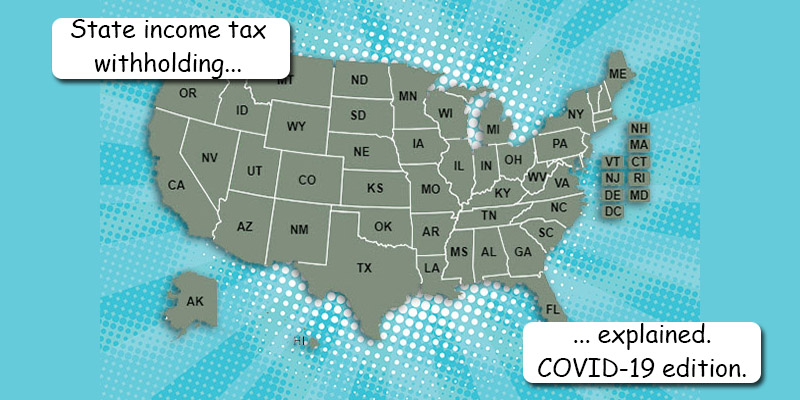
Unless you live and work in one of the following nine states that do not tax wages, you are required to withhold state income tax on wages paid to your employees: Alaska, Florida, Nevada, New Hampshire, South Dakota, Tennessee, Texas, Washington and Wyoming. While this may sound simple enough, there are a number of considerations that need to be made, and we will go over them here, including the COVID-19 wrench in the machine. The Form First up is the form itself. There are a few states that did not adopt their own state withholding tax form, so here is…

On August 8, 2020, the President issued an Executive Order (EO) to allow an employee to elect to defer their Social Security tax payment, on wages earned from September 1, 2020 through December 31, 2020, to a later date. Rightfully so, the EO lacked details on implementation, which would be up to the U.S. Treasury to determine. Late Friday afternoon on August 28, 2020, the IRS published Notice 2020-65, and while the notice does provide details, it is still lacking rules and guidance on many points. Most employers, since March 27, 2020, have had the ability to defer the deposit…
Both the SBA and the U.S. Treasury have been busy throughout the month of August. We have seen the loan approval process close on August 8, the loan forgiveness application process open on August 10 (sort of), forgiveness rules clarification with the August 11th update of their FAQs, and a new interim final rules published on August 24th. The closing of the PPP loan program is probably long overdue. After several extensions of the program, it appeared that the demand for the loan funds had come to a halt and there was not much of a demand for it in…
We have not seen much change in relation to PPP loan forgivness, although there are a few notable updates. Payroll costs includes the wages up to $100,000 of annualized pay per employee. For those using the eight-week covered period, that is a maximum of $15,385 per individual, and for those using the 24-week covered period, that will be a maximum of $46,154 per individual. A company does not have to wait the full 24-weeks to file for forgiveness if they meet the spending requirements sooner. Let’s say you spend 100% of the loan amount on payroll costs after just 10…
Yes, you have read that correctly. It is the PPP Flexibility Act of 2020. Why the need to include “2020?” Are they expecting a PPP Flexibility Act of 2021, 2022, and so on? The Paycheck Protection Program itself was not designed to last beyond 2020, so hopefully this is not a bad sign of what is ahead. Let’s take a moment to see how this latest Act impacts those who will be looking for forgiveness on their loan. I will assume you already understand basic PPP terms such as ‘payroll costs,’ ‘covered period,’ and FTE, but if you need a…