

It’s August, the sun is shining and one of your employees comes to you with what sounds like a harmless favor: “Hey boss! I’m heading up to a lake cabin in Maine for three weeks. I’ll still work my regular hours and get everything done. I just want to work with a view of the water!” Sounds great, right? It seems like an easy way to boost employee morale without spending an extra dime. Well, what sounds like a win-win situation may ultimately be a lose-lose. The moment that employee opens their laptop and performs work in another state, the…
Posts published in “Tax”
If your business paid late-filing or late-payment penalties to the IRS during the COVID-19 pandemic, a landmark court case could mean a massive refund is heading your way. In late 2025, the U.S. Court of Federal Claims handed down a major victory for taxpayers in Kwong v. United States. The court ruled that the IRS improperly assessed billions of dollars in penalties and interest during the pandemic. Because of how this ruling impacts the statute of limitations, affected businesses and individuals have a strict window to act, with a major deadline looming on July 10, 2026. Here is what you…
Restaurants face special rules for payroll, wages and tips that set them apart from most other businesses. In few industries do customers directly help pay employee wages through tips. These rules come mainly from the federal Fair Labor Standards Act (FLSA) and state laws, and can lead to common compliance issues, if not handled carefully. Minimum wage – While the federal minimum wage is $7.25 per hour, for tipped employees who engage in an occupation in which they customarily and regularly receive more than $30 per month in tips, their minimum wage is only $2.13 per hour in direct wages,…
Over the next few weeks, as your employees start to receive their 2025 W-2 form, they will likely have questions as to what all those numbers mean. For example, it is not uncommon for a salaried employee who earns a salary of “$50,000” per year question why their Box 1 Wages only reflects $45,000. Did they get underpaid? Probably not. If the employee contributes to a pension plan (aka 401(k)) or has pre-tax insurance deductions, then those amounts reduces the “taxable” wage, which is what is represented in Box 1. Some employees may also wonder why their Federal Income Tax…
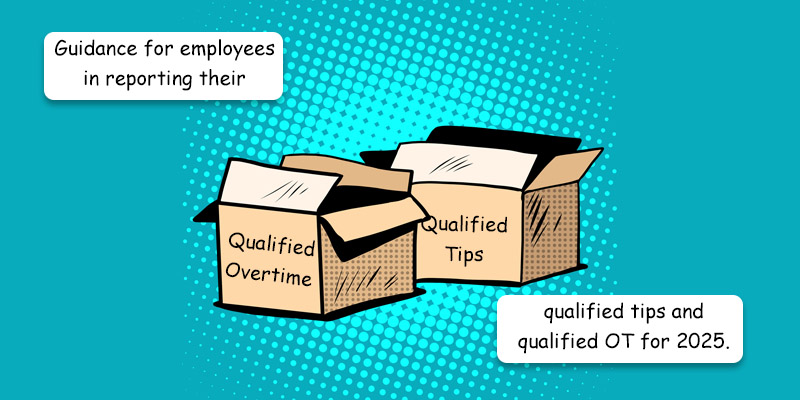
The IRS has recently published Guidance for Individual Taxpayers who received Qualified Tips or Qualified Overtime Compensation in 2025, Notice 2025-69, which provides direction and examples on how individuals will be able to calculate their Qualified Tips and Qualified Overtime and claim the deduction on their 2025 1040 tax return. Tax year 2025 is a transition year, due to the retroactive nature of its start and the inability of the IRS, Social Security Administration and payroll systems to implement the changes. The amounts arrived at, by the below methods, may not be 100% accurate, but it is acceptable for 2025, according…
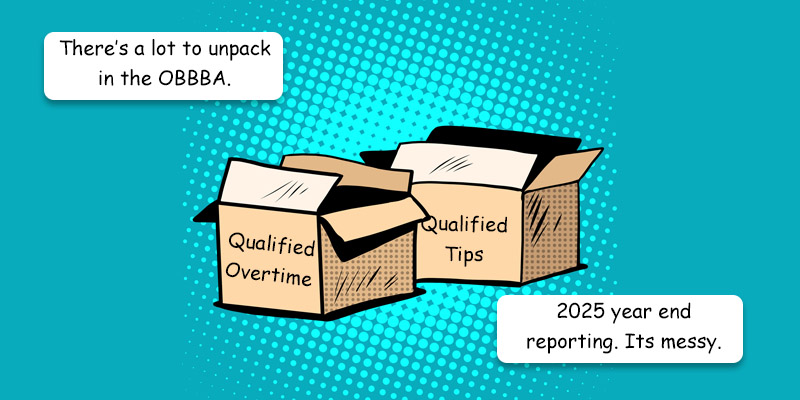
As discussed in our earlier blog post here, the One Big Beautiful Bill Act (OBBBA) allows for a provision of “no tax” on tips and overtime. This has turned out to be a bit of a mess, as it pertains to 2025 reporting to the employees, due to insufficient time for the Social Security Administration and the IRS to make the changes to their forms to account for it. Not to mention many payroll systems were not prepared for this brand new retroactive reporting, especially as it pertains to qualified overtime. With that being said, 2025 will be treated as…
The SECURE 2.0 Act of 2022 was designed to enhance retirement savings for Americans by making it easier and more affordable to save. Each year, since the signing of this act, we have seen plan rules change, and 2026 will mark another key change in how catch-up contributions will be handled for high wage earners. The current rules state that if you are aged 50 or over, at any point during the calendar year, you can contribute an additional $7,500 on top of the regular contribution limit. The latter is also known as a catch-up contribution. For 2025, the regular…
On Independence Day, 2025, President Trump signed into law the One Big Beautiful Bill Act. This 330-page act covers a great deal, most of which will not be discussed in this article, but since it does have an impact on the payroll world, I will review pertinent items including the no tax on tips and overtime provision and the retroactive change to the Employee Retention Tax Credit. Employee Retention Tax Credit For ERTC, there will be no credit allowed for claims involving the 3rd and 4th quarter 2021, filed after January 31, 2024. This is somewhat good news, as Congress…

Many businesses are leaving valuable payroll tax credits unclaimed, missing out on significant financial benefits. Programs like the Work Opportunity Tax Credit (WOTC), Federal Empowerment Zone (FEZ) Credits and Research and Development (R&D) credit offer substantial savings, yet they often go overlooked due to lack of awareness or resources. Here’s a closer look at these credits and how your business can capitalize on them: Work Opportunity Tax Credit (WOTC) Since its introduction in 1996, the WOTC incentivizes hiring from specific groups, such as veterans, long-term unemployed and individuals receiving government assistance. The Department of Labor estimates that one in five…
Currently, there is no federal law guaranteeing even one day of paid sick leave to workers, with the exception of federal contractors and government employees. There is the Family Medical Leave Act, but that simply provides the ability to take unpaid job-protected leave for specified family and medical reasons. There was an attempt back in 2016, where President Obama called on Congress to pass the Health Families Act which would have expanded sick leave to all private-sector workers, but it did not pass the House. Since that time, states and localities have taken action to provide all workers, within their…