
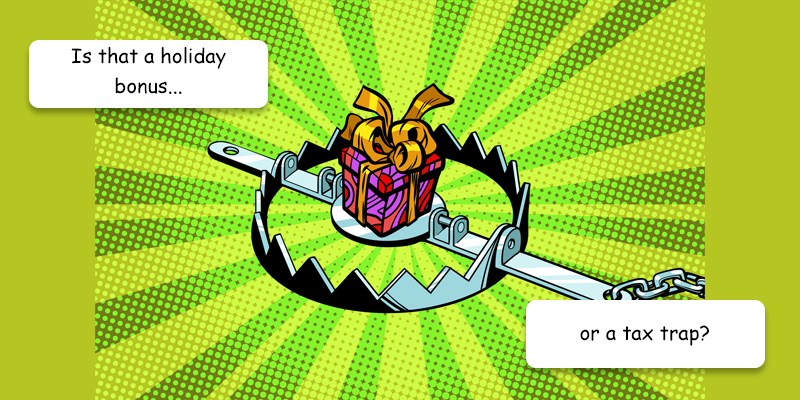
It’s that time of year again, the fourth quarter; where you want to show your appreciation for your team’s hard work and decide to give everyone a well-deserved $500 holiday bonus.
You process the checks, hand them out with a smile and wait for the holiday cheer.
Instead, an employee knocks on your door with a puzzled look, holding a paystub that reads $362.40.
“Hey boss, was there a mistake on my bonus check?”
There wasn’t a mistake. To you, that bonus was a generous holiday gift. But to the IRS, it’s compensation, and that means Uncle Sam wants his cut, and a big one at that.
Before you hand out checks or gift cards this season, here are three simple rules every employer should know to keep bonus season rewarding for your team and headache-free for your books:
Rule #1: Bonuses Are Considered “Supplemental Pay” (Why the Tax Bite Looks So Big)
When you run a regular payroll, federal income tax withholding is calculated based on an annualized formula using your employee’s Form W-4 elections.
A bonus, however, is classified by the IRS as supplemental wages.
Because supplemental wages do not follow the regular graduated withholding tables, the IRS sets a flat 22% federal withholding rate for supplemental payments under $1 million. When you add standard payroll taxes, 6.2% for Social Security and 1.45% for Medicare, plus applicable state and local income taxes, nearly 30% to 40% of that bonus can vanish before the employee sees their net pay.
If you don’t prepare your staff in advance, they often assume payroll made a math error. A quick heads-up to your team before bonus day goes a long way toward avoiding confusion.
It is also possible that adding a bonus amount to the employee’s regular paycheck could have a tax impact of greater than 22% in federal tax withholding. It all depends upon the size of the bonus, the employees normal pay and their selections on the W-4 form as to which method the employee will be taxed (withheld) less.
Rule #2: Want Them to Walk Away With $500? Use a “Gross-Up”
If your goal is for an employee to put an even, crisp $500 into their bank account, simply setting the gross amount to $500 won’t get you there.
This is where a gross-up comes in.
A gross-up is a payroll calculation where you work backward. You calculate the total taxes that will be withheld and add that amount to the gross wages upfront so that after all federal, FICAand state taxes are deducted, with the final net check equaling exactly $500.00.
- Desired Net Payout: $500.00
- Calculated Gross Wages: Approximately $710.00 – $750.00 (depending on your state’s tax rate)
Yes, it costs the company a bit more out-of-pocket, but it eliminates the disappointment of an odd, tax-whittled number.
The best part? You don’t have to manually figure out the reverse math. Just let us know the exact take-home amount you want your employees to receive and our PayMaster system will handle the gross-up calculations automatically.
Rule #3: Beware the Gift Card Trap
Every year, well-meaning business owners ask,“What if I skip payroll altogether and just hand out $50 Starbucks or Amazon gift cards? That doesn’t count as payroll,does it?”
Unfortunately, it does.
Under IRS rules, gift cards, gift certificates and prepaid credit cards are considered cash equivalents. Regardless of the dollar amount,even a $10 coffee card, cash equivalents are strictly taxable compensation. They cannot be classified as tax-free “de minimis” (minor) fringe benefits.
If you give employees gift cards, those amounts must be reported to payroll so that the proper taxes can be withheld and recorded on their Form W-2 before the calendar year closes.
What does qualify as tax-free?
- Traditional holiday gifts of property, such as a holiday turkey or a fruit basket
- Occasional company swag (jackets, mugs, tumblers)
- The company holiday party or team lunch
For more details as to what is and is not a taxable gift, check out our post from a few years ago: Gifts to Employees – A Taxing Topic
Plan Your Bonus Run Early
Whether you want to include holiday bonuses with your regular payroll, run a separate batch or gross them up to an even dollar amount, a little advance planning makes all the difference. Just reach out to our PayMaster team when you’re ready and we’ll make sure your bonus run is set up smoothly so you can focus on celebrating with your team.
