
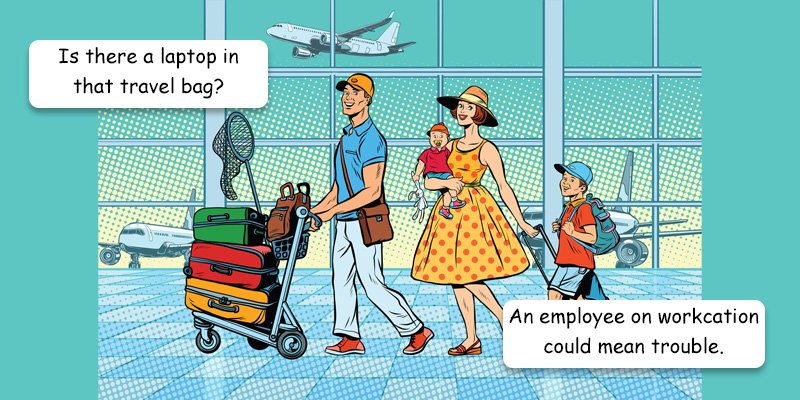
It’s August, the sun is shining and one of your employees comes to you with what sounds like a harmless favor:
“Hey boss! I’m heading up to a lake cabin in Maine for three weeks. I’ll still work my regular hours and get everything done. I just want to work with a view of the water!”
Sounds great, right? It seems like an easy way to boost employee morale without spending an extra dime. Well, what sounds like a win-win situation may ultimately be a lose-lose. The moment that employee opens their laptop and performs work in another state, the tax clock starts ticking. Welcome to the “Workcation” Tax Trap.
Let’s break down why a simple “workcation” can turn into a legal and financial headache, and how you can protect your business.
The Big Myth: “It’s Only Temporary!”
Most employers would never think of payroll taxes in a situation like this because it is only temporary. If an employee is traveling and stays out of state at a hotel or with relatives for just a couple of weeks, it may not raise an eyebrow, much less trigger having to register to do business in another state. Unfortunately, many states don’t see performing any work in their state as temporary and unwarranted of getting their share of taxes. State tax authorities care about where the employee is physically sitting when they perform the work, not where your business is located or where the employee normally lives.
Here are the major tax pitfalls that can spring up when an employee performs work out of state:
1. The “Day-1” Tax Trap
Some states are generous and give you a pass if an employee works there for less than 14, 30, or even 60 days. But other states? They want their cut starting on day one.
If your employee works from a rental house in a Day-one state, even for a single afternoon, you are technically required to register your business with that state and withhold their state income tax from their paycheck. Day-one states include, but are not limited to, Massachusetts, Michigan, Pennsylvania, New Jersey and Delaware. Two states, Arizona and Hawaii, have the most generous rule of 60 days, while all other states are somewhere in between. I have a table at the end of this article that lists each state, and the number of days an employee can work in a state, before state income tax withholding kicks in.
2. The “Convenience of the Employer” Complication
This is a fancy name for a rule that trips up almost every employer who encounters it. Normally, tax laws indicate that an employee owes taxes where they perform the work, but a handful of strict states use the “Convenience of the Employer” rule.
Under this rule, if an employee works remotely from another state for their own convenience (like taking a fun summer workcation) rather than because you forced them to move for business necessity, the home state still considers them a full-time worker in their eyes. States that enforce this rule include New York, Pennsylvania, Nebraska and Delaware.
What this means is that if your business is located in New York and your employee decides to work from a beach house in North Carolina for a month, New York says, “They are working away for their own convenience, so they still owe us New York tax!” Meanwhile, North Carolina says, “They are standing on our soil, so they owe us North Carolina tax!” Suddenly, your employee is being double-taxed, and you are stuck in the middle trying to figure out which state gets what.
3. Creating “Corporate Nexus” (The Big Financial Risk)
“Nexus” is just a legal word that means “your business has a big enough footprint in our state that we get to tax you.” Having just one employee working out of a temporary Airbnb in another state can trigger a “nexus.” That means you aren’t just dealing with payroll taxes for that person, that state might decide your whole business now owes corporate income taxes, needs a local business license or must set up a state unemployment insurance (SUTA) account.
States that fall under the corporate nexus rule include California, which immediately exposes your company to their corporate franchise tax, including a mandatory $800 minimum annual tax, even if your business barely made any income there. There are corporate income tax filing requirements for Texas and Washington, both of which have a gross receipts tax for sales sourced there. Florida and Illinois, also have similar requirements, where their laws explicitly indicate an employee performing work within their borders, regardless of where the company’s headquarters is located, will bring on state filing requirements for the business.
4. Local Labor Laws and Workers’ Comp
What happens if your employee trips over a rug in their Airbnb while walking to get a cup of coffee during work hours? That’s technically a workers’ compensation claim.
If your insurance policy only covers employees working in your home state, your insurance company might deny the claim. On top of that, local state laws apply to wherever the employee is physically sitting, meaning that if that state requires higher minimum wage, mandatory paid sick leave or daily overtime, you have to follow their rules while the employee is there.
4 Easy Rules to Keep You Out of Trouble
You don’t have to be the “bad guy” who bans summer travel completely, but you do need a few simple guardrails. Here is a quick checklist to keep your business safe:
- Require Advance Notice: Put a simple policy in your handbook: employees must ask for permission before working from another state. No surprise “workcations.”
- Set a Time Limit: Consider a hard limit on temporary remote work, and base the decision on the state to where the employee is traveling.
- Know Your “No-Go” States: If setting up payroll in certain strict states, like New York or California, is too expensive or complicated for your company, make a list of states where remote work isn’t allowed.
- Update Your Payroll Setup: If you do approve a longer out-of-state trip, let your payroll team and your payroll service know immediately. Register for tax accounts and properly reclassify the employee for wages earned while performing work in the temporary state.
The Bottom Line
Flexibility is a great perk, but unmanaged “workcations” can turn into a nightmare of back taxes, penalties and audit letters, sometimes years down the line. Catching these tax triggers before they happen is easy. Fixing them after a state tax board sends you an audit letter? That’s the expensive part.
| State | # Days | Dollar Threshold | Notes |
|---|---|---|---|
| Alabama | 1 | ||
| Arizona | 60 | ||
| Arkansas | 1 | ||
| California | $1,500 | ||
| Colorado | 1 | ||
| Connecticut | 15 | ||
| Delaware | 1 | ||
| Georgia | 23 | $5,000 | 1 |
| Hawaii | 60 | ||
| Idaho | $1,000 | ||
| Illinois | 30 | ||
| Indiana | 30 | ||
| Iowa | 1 | ||
| Kansas | 1 | ||
| Kentucky | 1 | ||
| Luisiana | 30 | ||
| Maine | 12 | $3,000 | 2 |
| Maryland | 1 | ||
| Massachusetts | 1 | ||
| Michigan | 1 | ||
| Minnesota | $15,300 | 3 | |
| Mississippi | 1 | ||
| Missouri | 1 | ||
| Montana | 30 | ||
| Nebraska | 1 | ||
| New Jersey | 1 | ||
| New Mexico | 15 | ||
| New York | 14 | ||
| North Carolina | 1 | ||
| North Dakota | 20 | ||
| Ohio | 1 | ||
| Okalahoma | $300 | 4 | |
| Oregon | 1 | ||
| Pennsylvania | 1 | ||
| Rhode Island | 1 | ||
| South Carolina | 1 | ||
| Utah | 20 | ||
| Vermont | 30 | ||
| Virginia | 1 | ||
| West Virginia | 30 | ||
| Wisconsin | $1,500 | ||
1. GA – 23 days per calendar quarter. $5,000 or 5% of total income.
2. ME – 12 days in a calendar year AND $3,000 in wages earned.
3. MN- Gross wage from all sources
4. OK – $300 per calendar quarter
States not listed above do not have state income tax: Alaska, Florida, Nevada, New Hampshire, South Dakota, Tennessee, Texas, Washington and Wyoming.
While I make every attempt to ensure the accuracy and reliability of the information provided in this article, the information is provided “as-is” without warranty of any kind. PayMaster, Inc and Romeo Chicco do not accept any responsibility or liability for the accuracy, content, completeness, legality, or reliability of the information contained. Tax laws can and will change. Consult with your CPA, Tax Attorney or HR Professional to ensure compliance.
