
Imagine finding out that one of your most reliable, long-term workers can no longer legally work for your business… effective immediately. That’s what happens when a sudden change in federal immigration law leaves you holding the bag. For many small business owners, this isn’t a hypothetical scenario. Following recent executive actions and Supreme Court rulings, the Department of Homeland Security (DHS) has officially ended Temporary Protected Status (TPS) for several countries, including Haiti, Syria, Yemen and Venezuela. If you employ workers under a TPS, this sudden shift puts you squarely in the middle of a tough spot: balancing loyalty to…
Posts tagged as “I-9”
Immigration and Customs Enforcement (ICE) was created in 2003, as part of the newly formed Department of Homeland Security (DHS,) following the September 11 attacks. The agency combined the enforcement and investigative branches of two older agencies: Immigration and Naturalization Service (INS,) which handled immigration matters and the U.S. Customs Service, which focused on border and trade enforcement. The goal was to strengthen national security by bringing immigration and customs enforcement under one roof. Today, one of ICE’s key responsibilities is ensuring that employers follow federal rules on verifying work eligibility through I-9 audits and, when necessary, workplace enforcement actions.…

We are often asked, in regards to rehires, if a new Form I-9 or E-Verify case is required. Employers have the option of treating all rehired employees as new hires by completing a new Form I-9 and creating a case in E-Verify. This may be the best practice because you will always have your bases covered. The only downside is the time it takes to perform the possible repetitive work. If you rehire a former employee within three years of the initial execution of the previous Form I-9 but did not create an E-Verify case and receive an ‘employment authorized’ response…
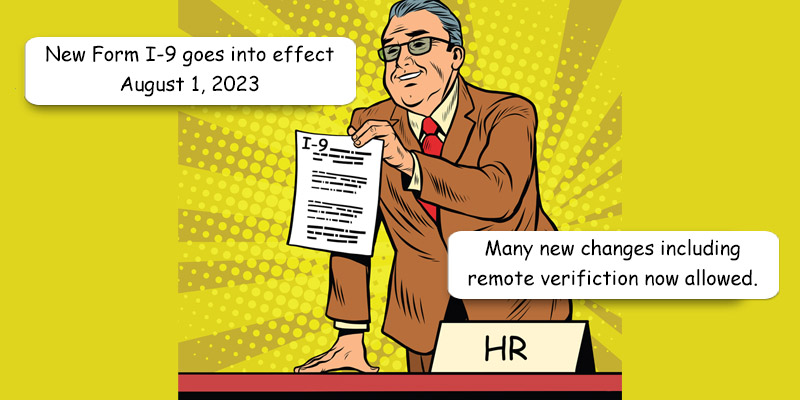
On August 1, 2023, the U.S. Citizenship and Immigration Services published the latest version of Form I-9. The new version can be downloaded here: https://www.uscis.gov/i-9. Employers should begin to use this new form immediately, and starting November 1, 2023, ONLY this new version will be allowed. If your employees use PayMaster HCM to complete the Form I-9, we will update to the new version in the coming weeks. There are many big changes with this version. Wording has been changed from ‘alien’ to ‘noncitizen,’ which I always thought was weird in the first place, and the form was redesigned to…

A question I am often asked is ‘How long must I maintain my payroll records?’, and the answer is; “it depends”. Reason being is that there are many different documents that are maintained within the payroll world by a myriad of federal, state, and local agencies, and a lots of overlap. Some people put a blanket retention policy of seven years across all documents, but in some cases as we will see, even that may not be long enough. Namely if the records are for an active employee. Let’s take a look at the more popular forms and documents, and bring some order to…

United States Citizenship and Immigration Services (USCIS) Form I-9 is used for verifying the identity and employment authorization of all individuals (citizens and non-citizens) hired for employment. On July 17th USCIS released a new form and employers have 60 days to implement this new version. First introduced in November 1986, this form is completed by both the newly hired Employee (where they state their eligibility to work -Section 1), and the Employer (where they verify the employee’s eligibility -Section 2) within three days of hire. The list of acceptable documents referenced by the employer to verify the employee’s eligibility…