
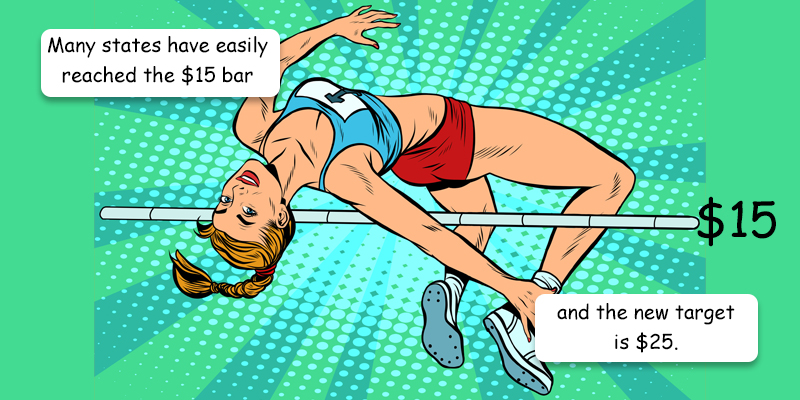
The Federal minimum wage has remained at $7.25 per hour since 2009, but 24 states and many cities, counties and locals have set increases effective January 1st, 2026, and a few effective during 2026. The state with the highest minimum wage is D.C. (yes, I know D.C. is not a state, but in any payroll system, D.C. is selected in the state field) at $17.95 an hour, and a number of cities within Washington state are well above $20.00 per hour. Back in the “old days” of 2012, we heard of the “Fight for $15.00” movement, and looking at the state list below, it has certainly been accomplished. But now that the target is met, labor advocates are setting their sights even higher. Currently in D.C., there is an initiative, coming to the forefront, to raise the minimum wage to $25 per hour with a deadline for it to be included on the November 2026 ballot.
A list of each state/local, along with the new hourly rate is listed below, which takes effect on January 1st, 2026 unless otherwise noted.
- Alaska: $14.00 7/1/2026
- Arizona: $15.15 ($12.15 for tipped employees)
- Flagstaff: $18.35 (same for tipped employees)
- Arkansas: $11.00 ($2.63 for tipped employees) No Increase
- California: $16.90
- $20.00 for fast food workers of chains of 60 or more locations. Food chains in California who make their own bread, like Panera Bread and Subway, are not subject.
- $18.00-$24.00 for health care workers based on employer type.
- Many Cities within California have a minimum wage and there are too many to list, click the link in this section for a list provided by UC Berkeley Labor Center.
- Colorado: $15.16 ($12.14 for tipped employees)
- Denver: $19.29 ($16.27 for tipped employees)
- Connecticut: $16.94
- Delaware: $15.00 No Increase
- District of Columbia (D.C.): $17.95 ($10.00 for tipped employees) No Increase
- Florida: $15.00 ($11.98 for tipped employees) 9/30/2026
- Hawaii: $16.00
- Illinois: $15.00 ($9.00 for tipped employees) No Increase
- Maine: $15.10 ($7.55 for tipped employees)
- Portland: $16.75 ($8.38 for tipped employees)
- Maryland: $15.00 No increase
- Montgomery County and Howard County workers have increased minimum wage
- Massachusetts: $15.00 ($6.75 for tipped employees ) $8.00 for agricultural workers. No increase
- Michigan: $13.73 for employees 18 & over ($5.49 for tipped employees) $11.30 for 16 & 17 year old employees (2/21/2026)
- Minnesota: $11.41 ($9.31 Training wage for workers under the age of 20 who are in training under certain conditions and applicable for 90 days.)
- Minneapolis: $16.37
- St. Paul: $16.37 for businesses with 101 or more employees, $16.37 for businesses with 6 to 100 employees (7/1/2026), and $13.25 for businesses with five or fewer employees (7/1/2026).
- Missouri: $15.00 ($7.50 for tipped employees)
- Montana: $10.85
- Nebraska: $15.00
- Nevada: $12.00 No increase
- New Jersey: $15.92; $15.23 for seasonal or less than 6 employees ($6.05 for tipped employees)
- New Mexico: $12.00 ($3.00 for tipped employees) No increase
- Las Cruces: $13.01 ($5.20 for tipped employees)
- New York: $16.00 ($10.70 for tipped employees)
- NYC: $17.00 ($11.35 for tipped employees)
- Long Island & Westchester: $17.00 ($11.35 for tipped employees)
- Ohio: $11.00 large employers ($5.50 for tipped employees); $7.25 for small employers with gross receipts of less than $405,000
- Oregon: $16.30 per hour inside the Portland urban growth boundary, $4.05 per hour in nonurban counties, and $15.05 in other areas of the state, and $14.05 for non-urban counties. New rates will publish by July 1, 2026 (TBD).
- Puerto Rico: $10.50 No increase
- Rhode Island: $16.00 Full-time students under 19 years of age working in nonprofit religious, educational, librarial, or community service organizations: $13.50
- South Dakota: $11.85 ($5.925 for tipped employees) Yes, that is a half penny. If your payroll system cant account for half penny rates, you better round up.
- U.S. Virgin Islands: $13.00
- Vermont: $14.42 ($7.21 for tipped employees)
- Virginia: $12.77
- Washington (state): $17.13
- Many Cities within Washington have a minimum wage and there are too many to list, click the link in this section for a list provided by Washington State Department of Labor & Industries.
- West Virginia: $8.75 ($2.62 for tipped employees)
A question we are often asked is in regards to the timing of the rate change. For example, if a rate change takes effect on January 1st, it is for work performed on or after that date. It is not based on the date the wages are paid. This means that if your biweekly pay period is from 12/18/2025 to 12/31/2025, with a check date of January 2, 2026, all of those hours worked would be paid at the 2025 rate, even though it is being paid in 2026. A situation occurs when your pay period straddles two different calendar years, and a few days needs to be paid at the old rate and a few days at the new. This may cause a nightmare of work if your timekeeping/payroll system cannot handle assigning rates based on the day worked. The easiest solution would be to pay the entire pay period at the new rate. Yes, one may see this as ‘overpaying’ the employees, but in most cases the added administrative work involved may overshadow the additional wages paid. With PayMaster HCM time & labor and payroll, rates are assigned on a daily basis, so mid-pay period rate changes are never an issue.
The following 20 states are all remaining at the Federal minimum wage level of $7.25 for any FLSA subject employers. They either have no minimum rate set, or it is lower than the federal $7.25 rate. A rate that has been in place since July 24th, 2009. Alabama, Georgia, Idaho, Indiana, Iowa, Kansas, Kentucky, Louisiana, Mississippi, New Hampshire, North Carolina, North Dakota, Oklahoma, Pennsylvania, South Carolina, Tennessee, Texas, Utah, Wisconsin, Wyoming.
A final note. If your state has enacted a rate change, this means that you will need to update your state labor poster.
The data listed is for general informational purposes only and should not be used as legal or professional advice. Please contact your state and local agency for more information regarding your State Minimum Wage as well as any exceptions that may exist for your business and/or your workers. Rates are subject to change.

[…] Minimum wage – While the federal minimum wage is $7.25 per hour, for tipped employees who engage in an occupation in which they customarily and regularly receive more than $30 per month in tips, their minimum wage is only $2.13 per hour in direct wages, as long as that amount, combined with the tips received, at least equals the federal minimum wage. Many states have a greater minimum wage, such as Florida, and also have a provision for a reduced minimum wage for tipped employees, where it is $14.00 per hour for regular employees and $10.98 per hour for tipped employees. The employee must earn at least $3.02 in tips per hour, otherwise the employer will need to pay the difference. Failure to do so will result in a FLSA minimum wage violation and can occur if tips are low or if employees don’t claim to the employer all of the cash tips they receive from the customer. […]